Creamy Chicken and Dumplings with Biscuits: Never Gummy

- Effort/Time: Moderate / 1 hour 5 mins
- Flavor Hook: Rich thyme-infused velouté with buttery, parsley-flecked biscuit clouds.
- Perfect for: Cold-weather Sunday suppers or high-protein make-ahead meal prep.
- The Architecture of Comfort: Master the Ultimate chicken and dumplings with biscuits
- The Thermal Dynamics of Steam-Leavened Dough
- Yield Metrics and Quantitative Culinary Data
- Molecular Foundations: Sourcing Your Pantry Elements
- Precision Hardware for Thermal Mass Management
- The Execution Protocol for a Velvety Emulsion
- Navigating Starch Retrogradation and Dough Density
- Structural Adaptations and Flavor Profile Modifications
- Scaling Logistics: Non-Linear Adjustments
- Cryogenic Logistics and Reheating Thermal Profiles
- The Aesthetic Interface: Finishing and Pairing
- Recipe FAQs
- 📝 Recipe Card
The Architecture of Comfort: Master the Ultimate chicken and dumplings with biscuits
We’ve all been there: you spend an hour hovering over a pot, only to bite into a dumpling that has the structural integrity of a damp sponge. Or worse, the "stew" is a thin, watery mess that refuses to cling to your spoon.
I remember my first attempt at chicken and dumplings with biscuits; I overcrowded the pot, the temperature plummeted, and I ended up with a grey, lackluster soup filled with leaden dough balls.
It was a texture less tragedy that sent me back to the drawing board to understand the physics of the steam cook.
The secret isn't just in the ingredients; it's in the thermal management of the pot. When you're making chicken and dumplings with biscuits, you're essentially building a pressurized steam chamber.
By using a heavy bottomed vessel like a Lodge Dutch Oven, you maintain a consistent 212°F (100°C) environment that forces leavening agents to react instantly.
This creates that elusive "shatter soft" crumb in the biscuit while the chicken thighs undergo perfect protein denaturation, turning tender without shredding into mush.
This version of chicken and dumplings with biscuits is engineered for maximum flavor density. We aren't just boiling meat; we are building layers of umami through a calculated Maillard reaction on the aromatics and a blonde roux stabilization.
The result is a glossy, velvety sheen that looks as good as it tastes. If you've ever struggled with thin sauces, this protocol will change your kitchen game forever. Trust me, once you see those biscuits rise like white gold clouds above the simmering broth, you’ll never go back to the "dump and hope" method.
The Thermal Dynamics of Steam Leavened Dough
- Maillard Dominance: Searing the 2 lbs of chicken thighs at high heat creates melanoidins, which provide the deep, savory backbone the stock alone cannot achieve.
- Starch Gelatinization: The 1/3 cup of all-purpose flour in the roux absorbs the 4 tbsp of melted butter and stock, swelling at 175°F to create a stable, non-breaking emulsion.
- Vapor Phase Leavening: Baking powder in the biscuits for chicken and dumplings releases CO2 gas when hitting the 212°F liquid, while the moisture in the dough turns to steam, pushing the gluten network upward.
- Collagen Breakdown: Simmering the chicken thighs allows the connective tissue to transform into gelatin, adding a natural "lip-smacking" viscosity to the final sauce.
Yield Metrics and Quantitative Culinary Data
Before you grab your Lodge Dutch Oven, let's look at the logistics. This recipe is optimized for a 6 quart vessel to ensure proper surface area for the biscuit expansion.
- Recipe Yield: 6 servings
- Prep Time: 20 minutes
- Cook Time: 45 minutes
- Total Time: 1 hour 5 mins
- Calories: 731 kcal per serving
- Protein: 37g
- Fat: 37g
- Carbohydrates: 47g
Molecular Foundations: Sourcing Your Pantry Elements
For the Stew Base
- 2 lbs boneless, skinless chicken thighs: Why this? Higher fat/collagen than breasts prevents drying during the 45 minute simmer. Use Perdue Chicken Thighs for consistent sizing.
- 4 tbsp unsalted butter: Why this? Provides the fat phase for the roux and a rich, nutty aroma. I prefer Kerrygold Unsalted Butter.
- 1/3 cup all-purpose flour: Why this? The primary thickening agent that prevents the heavy cream from curdling.King Arthur All-Purpose Flour is my go-to.
- 5 cups low-sodium chicken stock: Swanson Chicken Stock allows you to control the final salt concentration.
- 1 cup heavy cream: Adds the "velvety" texture and fat-soluble flavor carriers.
- 1 large onion (200g), diced: The sulfur compounds break down into sweetness.
- 3 carrots (150g) and 3 celery stalks (120g), sliced: The classic mirepoix foundation for aromatic depth.
- 1 tsp dried thyme & 1 bay leaf: Essential oils that cut through the richness of the dairy.
- 1 cup frozen peas: Added at the end to maintain vibrant chlorophyll color and "pop" texture.
For the Homemade Biscuits
- 2 cups all-purpose flour: The scaffold for our dumplings with biscuits.
- 1 tbsp baking powder: Why this? Dual action leavening ensures rise both upon mixing and hitting the heat.
- 1 tsp salt: I use Diamond Crystal Kosher Salt for its flaky texture and clean flavor.
- 1 cup whole milk: Hydrates the flour and provides lactose for subtle browning.
- 4 tbsp unsalted butter, melted: Coats gluten strands to ensure a tender, non-chewy crumb.
- 2 tbsp fresh parsley, chopped: Adds a grassy brightness to the dough.
Ingredient Chemistry Breakdown
| Ingredient | Chemical/Physical Role (Science) | The Pro Secret (Why This Matters) |
|---|---|---|
| Chicken Thighs | Protein denaturation & Gelatin release | Thighs stay juicy at 175°F+ while breasts turn to dry string. |
| Baking Powder | Chemical leavening (CO2 production) | Creates the "voids" in the dough that trap steam for fluffiness. |
| Heavy Cream | Fat-in-water emulsification | Stabilizes the sauce against over high heat "breaking" or separation. |
| Mirepoix | Enzymatic release of aromatic volatiles | Slow sweating builds a flavor base that water and bouillon can't mimic. |
Precision Hardware for Thermal Mass Management
Using the right tools is the difference between a soggy mess and a Masterclass level dish.
- Lodge 6 Quart Cast Iron Dutch Oven: Essential for heat retention. Cast iron prevents temperature "dips" when you add the cold milk based biscuit dough.
- OXO Good Grips Balloon Whisk: Used for the roux to ensure no raw flour clumps remain.
- Digital Kitchen Scale: To measure the 200g onion and 150g carrots accurately consistency is the hallmark of a pro.
- Wooden Spoon: Ideal for scraping the "fond" (browned bits) off the bottom of the pot.
The Execution Protocol for a Velvety Emulsion
1. Searing and Aromatics
Pat the 2 lbs of chicken thighs dry and season. Sear in the Lodge Dutch Oven for 8 minutes until a mahogany crust forms and the meat releases easily from the pan. This is the Maillard reaction in action. Remove the chicken.
Add the onion, carrots, and celery. Sauté for 6 minutes until the onions turn translucent and the sharp pungent smell shifts to a mellow sweetness.
2. Building the Velouté Base
Add 4 tbsp unsalted butter to the vegetables. Once melted and bubbling, sprinkle in the 1/3 cup all-purpose flour. Whisk constantly for 2 minutes until the mixture smells like toasted hazelnuts but hasn't turned dark brown.
This "blonde roux" is the thickening engine for your chicken and dumplings with biscuits.
3. Liquid Integration
Slowly pour in 1 cup of chicken stock while whisking vigorously. Repeat until all 5 cups are incorporated. Bring to a simmer until the liquid thickens enough to coat the back of a spoon. Add the chicken back in, along with the thyme and bay leaf. Much like the technique in my Gumbo recipe, this slow integration prevents lumps.
4. Simmering the Foundation
Reduce heat to low and cover. Simmer for 20 minutes until the carrots are fork tender and the chicken internal temperature reaches 175°F. At this stage, the collagen in the thighs is actively melting into the broth, creating a silky mouthfeel.
5. Preparing the Biscuit Dough
In a medium bowl, whisk 2 cups flour, 1 tbsp baking powder, and 1 tsp salt. Make a well in the center. Pour in 1 cup whole milk, 4 tbsp melted butter, and 2 tbsp parsley.
Stir with a fork until just combined and a shaggy, sticky dough forms. Over mixing here will develop too much gluten, leading to "hockey puck" results.
6. The Finishing Emulsion
Stir 1 cup heavy cream and 1 cup frozen peas into the pot. Taste for seasoning. The heavy cream adds a luxurious fat content that rounds out the acidic notes of the stock. For another creamy variation, you might see similar notes in our Chicken and Noodles Recipe.
7. Dropping the Dumplings
Using a large spoon, drop golf ball-sized portions of the dough onto the surface of the simmering liquid. Ensure you leave 1 inch of space between each for expansion. Do not submerge them; they need to sit on top like islands to benefit from the steam.
8. The Sealed Steam
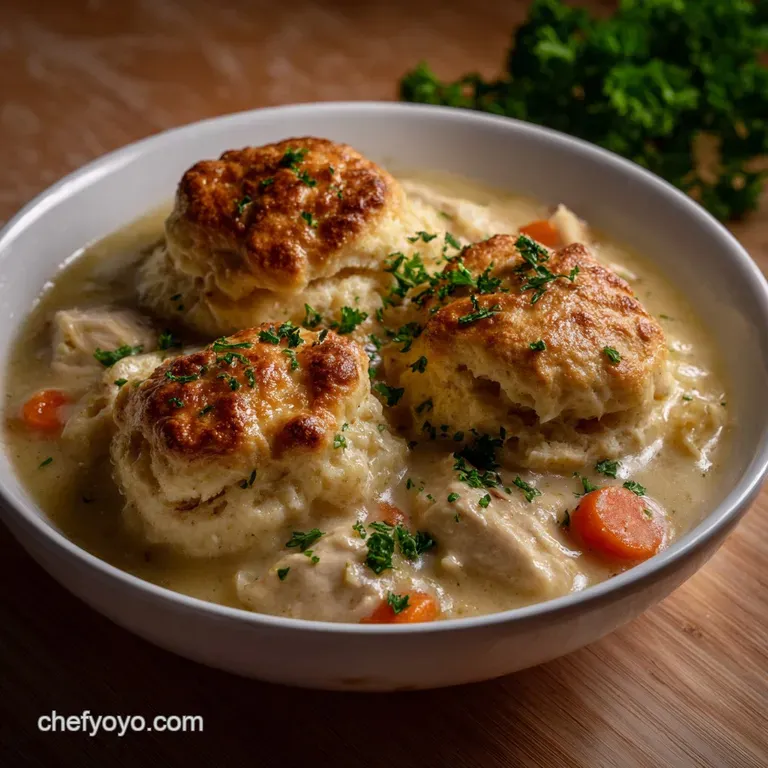
Cover the Dutch Oven with a tight fitting lid immediately. Cook for 15 minutes until the biscuits have doubled in size and a toothpick inserted into the center comes out clean.DO NOT LIFT THE LID during this time.
Lifting the lid releases the pressurized steam, causing the dumplings with biscuits to collapse and turn gummy.
9. Resting the Emulsion
Remove the pot from the heat and let it sit, covered, for 5 minutes. This allows the starch in the biscuits to "set" and the sauce to thicken further as the temperature drops slightly.
10. The Final Reveal
Garnish with extra parsley and serve. The biscuits should have a matte, puffed appearance, and the sauce should be glossy and thick.
Navigating Starch Retrogradation and Dough Density
Why Your dumplings with biscuits Are Leaden
If your biscuits feel like stones, the culprit is almost always "Gluten Over Development." When you over work the dough, the proteins (glutenin and gliadin) form a tight, elastic web. When the CO2 from the baking powder tries to expand, the web is too strong to stretch, resulting in a dense interior.
| Problem | Root Cause | The Fix | Pro Protocol |
|---|---|---|---|
| Gummy Interior | Lifted the lid too early | Keep lid sealed for full 15 mins | Use a glass lid if you're a "peeker" to monitor rise without heat loss. |
| Thin, Watery Sauce | Roux was not cooked long enough | Simmer longer without lid before adding biscuits | Mix a "beurre manié" (equal parts flour/butter) and whisk in if sauce is thin. |
| Bland Flavor | Lack of salt/acid balance | Add a splash of lemon juice or extra salt | Always season the chicken before searing to build flavor from the bone up. |
Why Your Sauce Breaks
A "broken" sauce looks curdled or oily. This happens when the emulsion of fat and water collapses. In creamy chicken and dumplings with biscuits, this is usually due to boiling too violently after adding the heavy cream.
Chef's Note: Keep the liquid at a "lazy bubble" never a rolling boil once the dairy is added. The milk proteins are sensitive to high shear and high heat.
Structural Adaptations and Flavor Profile Modifications
When you need homemade chicken and dumplings easy but want to switch things up, use these logic based swaps.
| Original Ingredient | Substitute | Why It Works |
|---|---|---|
| Heavy Cream (1 cup) | Full fat Coconut Milk | Similar fat content. Note: Adds a distinct nutty/tropical profile. |
| All-Purpose Flour | Cup4Cup gluten-free Flour | Starch heavy blend mimics the thickening power of wheat. |
| Chicken Thighs | Smoked Turkey Legs | Adds a deep, phenolic smoke flavor; requires longer simmer. |
| Whole Milk | Buttermilk | The acid reacts with baking powder for an even higher, tangier rise. |
1. Herb Infused Variation
For a "Provencal" twist, replace the thyme with a blend of rosemary and lavender. The aromatics will permeate the biscuit dough, creating a sensory experience similar to high end savory shortbread. If you enjoy this crumbly texture, check out my Butter Cookie Recipe for a sweet technical comparison.
2. Dietary Swaps (dairy-free)
To make this dairy-free, use a high-quality vegan butter (like Miyoko’s) and replace the milk with unsweetened soy milk. Soy milk has the highest protein content of plant milks, which is necessary for the structural integrity of the biscuits for chicken and dumplings.
Scaling Logistics: Non-Linear Adjustments
Scaling chicken and dumplings with biscuits isn't as simple as doubling everything. Physics gets in the way.
- The 1.5x Rule for Spices: If you double the batch, only use 1.5 tsp of thyme. Spices accumulate non-linearly in large volumes of liquid.
- Thermal Mass Warning: Doubling the recipe in one pot means the center will take significantly longer to reach a boil. Expect to add 10 15 minutes to the initial simmer time.
- Pan Crowding: Do not double the biscuits in the same sized pot. If they touch too much, they will steam each other into a singular, raw mass. Use two pots or cook in batches.
- Leavening Precision: Always scale the baking powder exactly. Chemical reactions rely on specific ratios; too much will lead to a bitter, metallic "soapy" taste.
Cryogenic Logistics and Reheating Thermal Profiles
Storage Protocols
- Fridge: Store in an airtight container for up to 4 days. The biscuits will naturally absorb some of the sauce, becoming softer over time.
- Freezer: Chicken and dumplings with biscuits freeze reasonably well for 2 months, but the texture of the biscuit will change. It becomes more like a "boiled dumpling" than a fluffy biscuit upon thawing.
The Reheating Science
Avoid the microwave if possible. It vibrates water molecules too fast, causing the chicken to turn rubbery (protein tightening) and the biscuits to become "tough." The Pro Method: Place the leftovers in a small saucepan with 2 tbsp of chicken stock.
Cover and heat on low for 10 minutes. The steam from the stock will re-hydrate the biscuit without destroying the crumb structure.
Zero Waste Philosophy
- Chicken Scraps: Don't discard the fat trimmed from the thighs. Transform: Render it down in a pan to make "schmaltz." Science: This chicken fat has a high smoke point and intense flavor, perfect for roasting potatoes the next day.
- Parsley Stems: Don't toss them! Finely mince and add to the mirepoix. The stems contain more concentrated flavor than the leaves.
The Aesthetic Interface: Finishing and Pairing
When serving chicken dumpling with biscuits, the goal is a balance of textures. The bottom of the biscuit should be slightly "saturated" with the rich gravy, while the top remains dry and fluffy.
Myth: You must sear the chicken until it's fully cooked. Truth: Searing is only for flavor (Maillard). The chicken actually cooks during the simmering phase. If you cook it fully during the sear, it will be overdone and dry by the time the biscuits are ready.
Myth: You can use "canned" biscuits for the same result. Truth: Canned biscuits contain stabilizers and oils that often "melt" into the soup rather than steaming.
Homemade chicken and dumplings easy starts with a simple flour and milk dough for a far superior, "clean" flavor profile.
This quick chicken dumplings method ensures that every bite is a calibration of salt, fat, and acid. The frozen peas provide the necessary pop of sweetness to break through the heavy cream. If you're looking for another soul warming meal, consider trying a Gumbo recipe which uses a similar roux based thickening logic but with a darker, more complex flavor profile. Whether it's a rainy Tuesday or a celebratory Sunday, this recipe for and dumplings with biscuits is the gold standard for home cooked excellence.
Final tip: Always serve in shallow bowls. It allows the dumplings with biscuits to spread out, giving you the perfect ratio of biscuit-to-gravy in every single spoonful. Enjoy the sizzle of the sear and the aroma of the thyme you've earned it.

Recipe FAQs
How can I ensure my biscuit dumplings are fluffy and not dense?
Do not lift the lid during the 15-minute steam period. Releasing the trapped steam collapses the CO2 bubbles that provide lift, leading to a gummy structure. The trapped vapor is essential for fully setting the dough’s structure.
- Mix dough only until just combined
- Ensure baking powder is fresh and active
- Drop dough onto simmering, not boiling, liquid
What is the best internal temperature for the chicken thighs?
Can I substitute chicken breasts for the thighs?
Why is my creamy sauce separating or looking curdled?
- Remove pan from heat first
- Add cheese in small handfuls
- Use fresh grated Gruyère (pre-shredded has cellulose coating)
Should I use salted or unsalted butter for the roux?
Is searing the chicken before simmering necessary?
How should I reheat leftovers to maintain texture?
Fluffy Chicken And Biscuits
Ingredients:
Instructions:
Nutrition Facts:
| Calories | 731 kcal |
|---|---|
| Protein | 37g |
| Fat | 37g |
| Carbs | 47g |
| Fiber | 3g |
| Sugar | 5g |
| Sodium | 1150mg |
