Smoked Beef Jerky: Savory and Chewy
- Time: Active 810 minutes, Passive 300 minutes, Total 1110 minutes
- Flavor/Texture Hook: Savory, smoky, and satisfyingly chewy
- Perfect for: High protein meal prep and long outdoor adventures
- Create the Most Vibrant Savory Smoked Beef Jerky
- Why This Works
- Component Analysis: The Pillars of Flavor
- Layering Innovative Flavors into Your Shopping Basket
- The Step-by-Step Flow From Prep to Plate
- Avoiding Kitchen Disasters and Ensuring Flavor Balance
- Adjusting Batch Sizes for Large Crowds or Small Snacking
- Debunking Misconceptions About Homemade Dehydrated Meat
- Keeping Your Jerky Fresh and Reducing Kitchen Waste
- Innovative Serving Ideas for Your Smoked Snack
- Recipe FAQs
- 📝 Recipe Card
Create the Most Vibrant Savory Smoked Beef Jerky
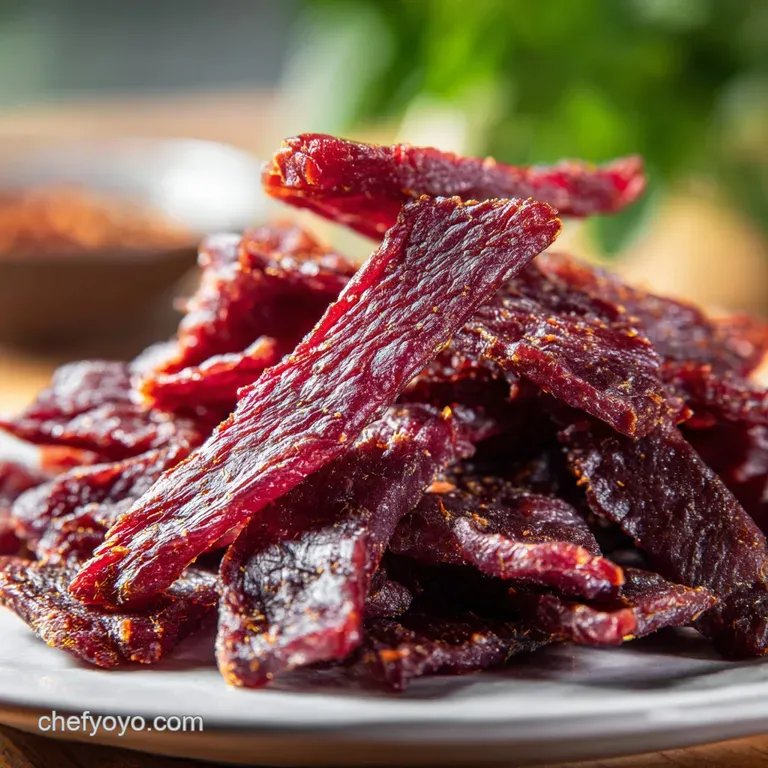
The first time I pulled a tray of warm, dark mahogany strips from the smoker, the aroma hit me like a physical wave a fusion of sharp hickory smoke, sweet maple, and the deep, fermented tang of soy.
It wasn't just meat; it was a concentrated explosion of flavor that made my kitchen smell like the best smokehouse in the city. I remember the specific "snap" of the first piece I tried, the way it yielded just enough to feel substantial without being tough, revealing those vibrant white fibers that signal a flawless cure.
This wasn't the dusty, salt bomb leather you find at a gas station; it was something innovative and alive.
For this recipe, our hero ingredient is the Beef Eye of Round. I chose this specific cut because it is lean, uniform, and remarkably dense. In the world of meat dehydration, fat is the enemy because it doesn't dry out it goes rancid.
While other home cooks might reach for flank steak, the Eye of Round offers a cleaner canvas for our vibrant marinade to soak into every fiber. Substitutes like top round work in a pinch, but they often lack the structural integrity we need for those long, beautiful strips.
Trust me, once you see how this lean muscle transforms under low heat, you’ll never look at a "shortcut" bag of jerky the same way again.
Why This Works
The secret to this smoked beef jerky recipe lies in how we manage moisture and cellular structure through a process that feels like magic but is actually just smart cooking.
- Cellular Saturation: The salt in the soy sauce and Prague Powder breaks down the protein strands, allowing the maple syrup and spices to penetrate deep into the core of the meat.
- The Pellicle Layer: By patting the meat dry before smoking, we create a tacky surface called a pellicle that acts as a magnet for smoke particles, ensuring a vibrant mahogany finish.
- Controlled Denaturation: Low heat at 165°F (74°C) slowly removes water while keeping the proteins flexible, preventing the meat from becoming brittle or "shattering."
- Curing Stability: Prague Powder #1 inhibits bacterial growth during the long, low temperature cook, keeping the snack safe for weeks.
| Cooking Method | Time | Texture | Best For |
|---|---|---|---|
| Pellet Smoker | 5 hours | Deeply smoky, chewy | Authentic flavor depth |
| Kitchen Oven | 6 hours 30 mins | Clean, savory | Convenience / No smoker |
| Dehydrator | 8 hours | Consistent, uniform | Large batches, lean results |
Choosing the right method changes the soul of the dish. While a dehydrator is efficient, it lacks the fusion of wood fire that a pellet grill provides. If you use an oven, keep the door propped open slightly with a wooden spoon to let moisture escape, or you'll end up steaming the meat instead of drying it.
Component Analysis: The Pillars of Flavor
The best smoked beef jerky marinade isn't just a liquid; it's a chemical environment designed to transform raw muscle into a shelf stable masterpiece.
| Ingredient | Science Role | Pro Secret |
|---|---|---|
| Beef Eye of Round | Protein Matrix | Freeze for 90 minutes before slicing for razor thin, uniform strips. |
| Prague Powder #1 | Antimicrobial Cure | Never skip this; it provides the classic pink hue and prevents botulism. |
| Maple Syrup | Hygroscopic Sweetener | Balances the salt and helps the marinade "stick" to the fibers. |
| Apple Cider Vinegar | Acidic Tenderizer | Breaks down tough connective tissue for a better "bite" and snap. |
Using the right beef is non negotiable. If you find yourself with scraps or trimmings that are too fatty for jerky, don't throw them away. Those fatty bits are a flavor goldmine for a cozy beef stew where the fat can actually render and provide a velvety mouthfeel.
Layering Innovative Flavors into Your Shopping Basket
To achieve a result that feels truly high end, we need to be precise with our shopping. This isn't just "beef and salt"; it’s a calculated fusion of tastes.
- Beef Eye of Round (2 lbs): Look for the leanest roast available. Why this? Minimal fat prevents rancidity and ensures a long shelf life. (Substitute: London Broil)
- Low sodium Soy Sauce (1/2 cup): The base of our umami profile. Why this? Controls the salt level while providing deep, fermented notes. (Substitute: Tamari)
- Worcestershire Sauce (1/4 cup): Adds a complex, vinegary punch. Why this? Anchovies and tamarind add layers that salt alone cannot. (Substitute: Steak sauce)
- Apple Cider Vinegar (2 tbsp): Brightens the heavy savory notes. Why this? The acidity tenderizes the lean muscle fibers. (Substitute: Rice vinegar)
- Smoked Paprika (1 tbsp): Enhances the natural fire kissed flavor. Why this? Provides a vibrant red color and earthy depth. (Substitute: Chipotle powder)
- Onion & Garlic Powder (1 tsp each): The foundational aromatics. Why this? Powders distribute more evenly than fresh in a long marinade. (Substitute: Granulated versions)
- Coarsely Cracked Black Pepper (2 tsp): Provides a sharp, textural bite. Why this? Larger cracks release oils slowly during the smoke. (Substitute: White pepper)
- Prague Powder #1 (1/2 tsp): Our safety insurance. Why this? Essential for long term storage and that classic jerky "look". (Substitute: None recommended for safety)
- Maple Syrup (1 tbsp): A touch of North Woods sweetness. Why this? The sugar caramelizes slightly, creating a glossy finish. (Substitute: Brown sugar)
The step-by-step Flow From Prep to Plate
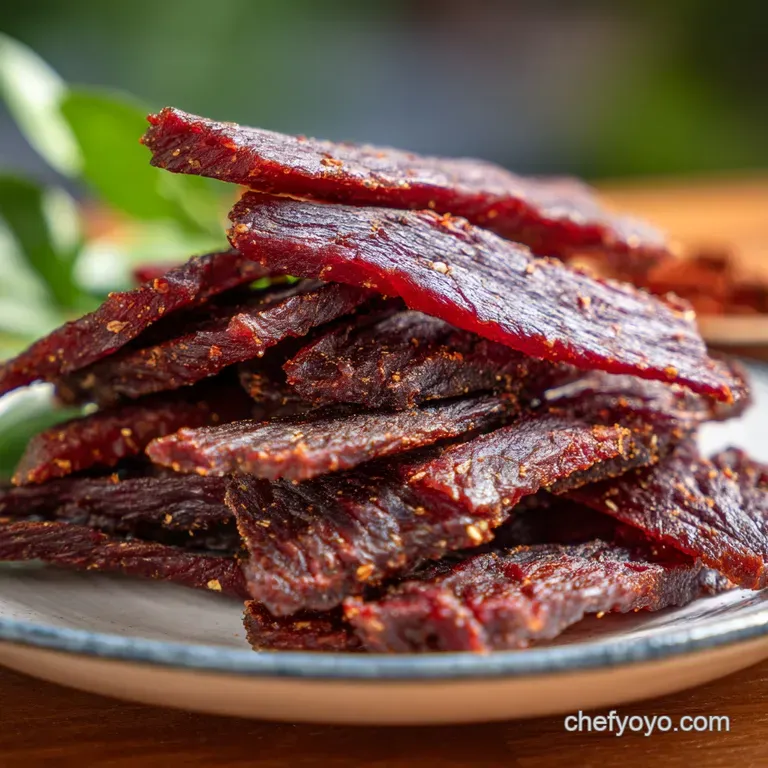
The process of making homemade smoked beef jerky requires patience, but the rewards are found in the details. Follow these steps to ensure your batch is safe and savory.
- Freeze the beef. Place the Eye of Round in the freezer for 60 to 90 minutes until firm but not solid. Note: This makes the meat act like a block of wood for cleaner slicing.
- Slice against grain. Cut the beef into 1/8 inch thick strips, moving across the muscle fibers. Note: Slicing with the grain creates "leather," while against the grain creates a tender "snap."
- Whisk the marinade. Combine soy sauce, Worcestershire, vinegar, all spices, Prague powder, and maple syrup in a bowl.
- Saturation phase. Place beef and liquid in a gallon Ziploc, removing all air, and refrigerate for 12 to 24 hours.
- Preheat the smoker. Set your pellet grill smoked beef jerky station to 165°F (74°C) with hickory or cherry wood.
- Dry the strips. Pat every single strip of beef bone dry with paper towels before placing them on the racks. Watch for the surface becoming tacky.
- Arrange the meat. Lay strips on wire racks, ensuring they don't touch. Note: Airflow is just as important as heat for dehydration.
- Smoke the batch. Cook for 4 to 6 hours until the meat bends and cracks to show white fibers.
- Cool completely. Transfer the jerky to a paper towel lined tray for 30 minutes. Note: This prevents condensation in your storage bag.
Avoiding Kitchen Disasters and Ensuring Flavor Balance
Even the most seasoned cooks can run into trouble when dehydrating meat. The key is to watch the texture, not just the clock. When learning how to smoke beef jerky, your eyes and hands are your best tools.
Why Your Jerky Is Brittle
If your jerky snaps like a cracker, you’ve likely overcooked it or the temperature was too high. Jerky should be flexible. This often happens if the slices are uneven thin pieces dry out while thick ones stay raw. Always aim for that 1/8 inch consistency.
Why the Texture Is Rubbery
Rubbery jerky usually stems from two things: slicing with the grain or failing to pat the meat dry. If the surface is wet when it hits the smoker, the meat "stews" in its own moisture. That's why the pat dry step is the one most people skip, but it's the most critical for a clean bite.
| Problem | Root Cause | Solution |
|---|---|---|
| Greasy surface | Excess fat on meat | Trim beef more aggressively before slicing |
| Salty "Bloom" | Salt migrating to surface | Reduce soy sauce or increase maple syrup next time |
| Uneven drying | Poor airflow | Use wire racks and don't overlap strips |
Common Mistakes Checklist
- ✓ Always trim every visible speck of white fat; fat does not dry and will spoil the whole bag.
- ✓ Ensure the smoker temperature stays at 165°F (74°C); going higher will cook the meat rather than dry it.
- ✓ Don't skip the refrigeration; the meat needs at least 12 hours to absorb the cure for safety.
- ✓ Check the "bend" at the 4 hour mark; every smoker is different, and humidity affects the time.
- ✓ Let the jerky breathe for 30 minutes after cooking; bagging it hot creates steam and mold risk.
Adjusting Batch Sizes for Large Crowds or Small Snacking
Scaling this easy smoked beef jerky recipe is straightforward, but you need to be mindful of the salt and cure ratios.
Scaling Down (1 lb Beef) If you're just making a small snack, halve everything. Use a smaller Ziploc bag to ensure the meat is fully submerged in the marinade. You can use a smaller wire rack in your smoker or even a toaster oven if it has a very low "warm" setting (though the smoke flavor will be missing).
Scaling Up (4-8 lbs Beef) When doubling or tripling, do not double the salt or spices linearly. Use 1.5x the amount of spices and liquids first, then taste. However, always maintain the ratio of Prague Powder #1 (typically 1 level teaspoon per 5 lbs of meat) for safety.
You’ll need to rotate your racks every 2 hours to ensure even airflow, as a crowded smoker creates "cold spots" where moisture can linger.
| Servings | Beef Amount | Marinade Total | Rack Space |
|---|---|---|---|
| 8 People | 1 lb | 1/2 cup liquid | 1 small rack |
| 16 People | 2 lbs | 1 cup liquid | 2 large racks |
| 32 People | 4 lbs | 1.75 cups liquid | 4 large racks |
Debunking Misconceptions About Homemade Dehydrated Meat
There are a lot of old wives' tales floating around the world of preservation. Let's set the record straight so you can cook with confidence.
Myth: You don't need curing salt if you're eating it quickly. Actually, "hot smoking" at 165°F (74°C) places the meat in the bacterial "danger zone" for several hours.
Without Prague Powder #1, you are taking a significant risk with foodborne illness, regardless of how fast you plan to eat it. The cure isn't just for shelf life; it's for safety during the long cook.
Myth: Searing the meat first locks in flavor. This is a mistake I see often. Searing creates a crust that prevents the smoke from penetrating the fibers. For the best smoked beef jerky, you want the smoke to enter the raw, marinated meat immediately.
The "crust" should form naturally during the dehydration process, not through over high heat searing.
Myth: Liquid smoke is just as good as a real smoker. While liquid smoke can add flavor, it lacks the drying power and airflow of a pellet grill or smoker. Real smoke contains hundreds of compounds that create a more innovative, complex taste profile.
If you're using an oven, liquid smoke is a decent compromise, but it won't give you that vibrant mahogany color.
Keeping Your Jerky Fresh and Reducing Kitchen Waste
Once you've put in 18 hours 30 mins of work, you want that jerky to stay vibrant and fresh for as long as possible.
- Fridge
- Store in an airtight container for up to 3 weeks.
- Freezer
- Jerky freezes beautifully! Vacuum seal it for up to 6 months.
- Pantry
- If you've used Prague powder and dried it correctly (the "white fiber" test), it can stay in a cool, dark place for 1 week, but I always recommend the fridge for maximum freshness.
Zero Waste Tips Don't toss the leftover marinade! While you can't reuse it for another batch of meat (due to bacteria), you can boil it for 10 minutes to kill any pathogens and use it as a base for a stir fry sauce or a savory glaze for beef sliders. Also, those small "crumb" pieces at the bottom of the bag? Save them! They are incredible when finely chopped and sprinkled over a baked potato or stirred into a morning omelet for a burst of smoky umami.
Innovative Serving Ideas for Your Smoked Snack
While jerky is the ultimate grab and-go food, you can get creative with how you present it to friends or include it in your daily meals.
The Geometry of the Grain
For a sophisticated look, serve your jerky strips vertically in a glass jar. This keeps them from getting squished and makes for a vibrant centerpiece at a backyard barbecue. It allows guests to see the beautiful texture and color of the smoke ring.
The "Firehouse" Twist
If you want to add an extra layer of heat, brush the strips with a tiny bit of Sriracha or honey habanero glaze during the last 30 minutes of smoking. The sugar will tack up and create a "sticky" jerky style that is popular in innovative Asian fusion smokehouses.
High Protein Pairing
Jerky isn't just for trails. I love chopping up a few strips of this homemade smoked beef jerky and adding it to a charcuterie board alongside sharp cheddar and green apples. The saltiness of the beef cuts through the creaminess of the cheese perfectly.
It's also a great way to stay full between larger meals, especially if you're planning on a heavy dinner later.
Making your own jerky is more than just a recipe; it's a way to connect with a style of cooking that is both ancient and entirely modern. By using vibrant spices and innovative techniques, you're creating a snack that is light years ahead of anything you can buy in a store.
Enjoy the process, watch the smoke roll, and get ready for the best beef you've ever had.
Recipe FAQs
How long does it take to smoke beef jerky on a smoker?
Smoke for 4 to 6 hours. Begin checking the texture at the 4-hour mark, as individual smoker efficiency and ambient humidity can significantly alter the drying rate.
Which beef jerky is best for diabetics?
This recipe is a solid choice because it relies on savory aromatics rather than heavy sugar. By using only 1 tablespoon of maple syrup across 16 servings, the sugar content per piece remains very low, making it a better option than most store-bought varieties loaded with corn syrup.
Is beef jerky good for anemia?
Yes, lean beef is a concentrated source of heme iron. Because this recipe uses Eye of Round trimmed of all fat, you are consuming high-quality protein and iron, which are essential components for managing healthy blood levels.
Is beef jerky good for cholesterol?
It depends on how thoroughly you trim the fat. Cholesterol management is easier when you carefully remove all visible white fat before marinating, which prevents saturated fat intake while providing a high protein, low-calorie snack.
Is it true I can cook the jerky faster at higher temperatures?
No, this is a common misconception. You must maintain the smoker at 165°F (74°C) because higher temperatures will cook the meat and seal the outside before the moisture has a chance to evaporate, which leads to spoilage.
How to ensure the jerky doesn't spoil during storage?
Let the finished strips breathe at room temperature for 30 minutes before bagging. If you seal the jerky while it is still warm, the trapped steam will create moisture inside the bag, causing mold to form rapidly. If you enjoyed mastering these moisture control techniques for shelf stability, you will find similar cooling principles essential when resting other meat based dishes.
How to get consistent slices for even drying?
Place the beef in the freezer for 60 90 minutes before slicing. Firming the meat up in the freezer makes it much easier to cut uniform 1/8 inch strips, which ensures that every piece finishes drying at the same time.
Homemade Smoked Beef Jerky
Ingredients:
Instructions:
Nutrition Facts:
| Calories | 86 kcal |
|---|---|
| Protein | 13.1 g |
| Fat | 2.2 g |
| Carbs | 2.4 g |
| Fiber | 0.3 g |
| Sugar | 1.3 g |
| Sodium | 342 mg |
