The Perfect Press Unlocking Rich Fullbodied Coffee Every Time
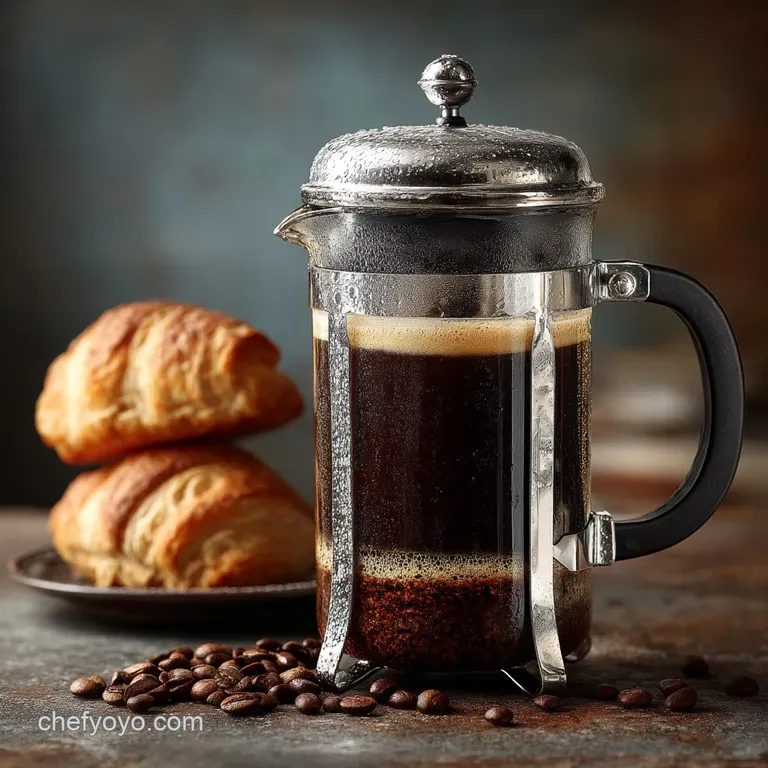
- Why the French Press Reigns Supreme Over Automatic Brewers
- Demystifying the Richness: The Science Behind Immersion Brewing
- The Essential Toolkit for Flawless French Press Coffee Preparation
- Mastering the Golden Ratio: Coffee to Water Measurements
- Step-by-Step Immersion: Achieving Optimal Saturation
- The Crucial Waiting Game: Dialing In Your Brew Time
- Troubleshooting Common Pitfalls in Your French Press Coffee Preparation
- Recipe FAQs
- 📝 Recipe Card
Why the French Press Reigns Supreme Over Automatic Brewers
Forget the lukewarm, sputtering performance of many automatic drip machines. The French Press, or cafetière , offers a fundamental advantage rooted in its simplicity: full immersion.
Where automatic brewers rely on showerheads that often fail to saturate the grounds evenly, the French Press submerges every single particle of coffee in hot water for the entire duration of the steep.
This direct, prolonged contact is the key to unlocking profound flavour depth that automated systems simply cannot replicate. It’s a hands-on experience that yields a cup of coffee brimming with character, making the French Press Coffee Preparation method beloved by aficionados for decades.
Demystifying the Richness: The Science Behind Immersion Brewing
The magic of the French Press lies entirely in its immersion technique. Unlike pour over methods that rely on gravity and speed to extract flavour, immersion allows for a slower, more comprehensive flavour dissolution. This results in a cup that possesses a distinct texture and aromatic profile that sets it apart.
Your Path to Superior Morning Aromatics
When you make How To Make Coffee In A French Press , you are allowing the volatile aromatic compounds trapped within the coffee bean structure to fully release into the water without the restrictions of a paper filter.
These oils, which carry much of the nuanced flavour notes citrus, chocolate, floral notes remain suspended in the final brew, contributing significantly to the overall sensory experience.
The Velvet Texture: Understanding Full Bodied Extraction
The defining characteristic of this brewing style is its body. Because the standard French Press uses a relatively coarse metal mesh filter, it allows micro fines and essential coffee oils to pass through into your mug.
These minute particles physically interact with your tongue, creating a heavier mouthfeel often described as 'velvety' or 'chewy.' This full bodied extraction is precisely what differentiates a robust French Press brew from a lighter, cleaner cup produced by a paper filter method.
A Quick Nod to the Cafetière's History
While modern iterations are sleek, the concept of brewing coffee by steeping grounds has a long history. The earliest patents tracing back to the mid-19th century in France established the blueprint: a vessel for steeping, a filtering mechanism, and a plunger.
This enduring design proves the fundamental effectiveness of the principle, making the French Press Coffee Method a classic for a reason.
The Essential Toolkit for Flawless French Press Coffee Preparation
To achieve consistency in your brew, having the right tools is paramount. While the press itself is the centerpiece, supporting equipment dictates the success of your final cup. Mastering the French Press Coffee Making Process starts long before the water hits the grounds.
Related Recipes Worth Trying
- The Best Coffee Cinnamon Rolls with Espresso Glaze — Elevate your weekend brunch with these rich Coffee Cinnamon Rolls packed with real espresso flavour Get the foolproof coffee sweet rolls recipe here
- The Ultimate Caramelised French Onion Soup Recipe Bistro Style — Master the Best French Onion Soup at home This rich recipe guarantees deeply savoury broth and perfectly melted Gruyère Get the foolproof steps now
- Boozy White Russian Panna Cotta with Coffee Caramel — Elevate the classic White Russian cocktail into a creamy Panna Cotta dessert This boozy drink recipe is surprisingly easy to set Get the recipe
Mastering the Golden Ratio: Coffee to Water Measurements
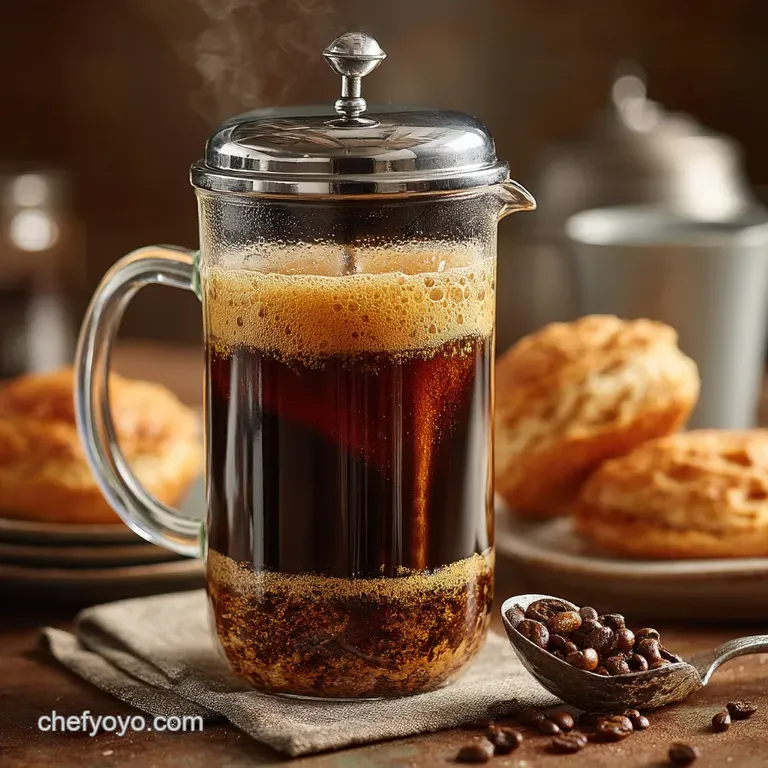
The foundation of excellent coffee, regardless of the apparatus, is precise measurement. For the immersion technique, we typically favour a slightly stronger ratio than drip brewing to account for the robust extraction.
A good starting point for our Best French Press Coffee Recipe uses a ratio close to 1 part coffee to 15 parts water by weight. For a standard 12-ounce (350 ml) press, this translates to approximately 30 grams of freshly roasted whole bean coffee.
Precision here ensures you avoid the pitfalls of weak or overly bitter results.
Selecting the Perfect Bean: Grind Consistency is Non-Negotiable
The single most critical variable in successful French Press Coffee Preparation is the grind size. Because the coffee grounds remain in contact with the water for the entire French Press Coffee Brewing Time , a fine grind will over extract rapidly, resulting in a muddy, bitter cup.
You must aim for a coarse, uniform consistency , resembling coarse sea salt or breadcrumbs. A high-quality burr grinder is highly recommended to achieve this uniformity, avoiding the inconsistent dust and boulders produced by blade grinders.
Water Temperature: The Unsung Hero of Extraction
Water temperature controls the speed and efficiency of flavour extraction. If the water is too cool (below 195° F/ 90° C), you risk under extraction, resulting in sour, thin coffee.
If it’s boiling ( 212° F/ 100° C), you risk scalding the grounds, leading to harsh, burnt notes. The ideal temperature for this immersion brew rests precisely between 195° F and 205° F ( 90° C to 96° C) .
A simple trick if you lack a thermometer is to let your kettle rest for about 45 seconds after it reaches a full boil.
Must Have Gear Beyond the Carafe
While the press is essential, investing in a digital scale allows you to accurately measure your 30 grams of beans and track your water volume precisely, taking the guesswork out of the How Much Coffee For French Press question.
On top of that,, a simple timer is non-negotiable for managing the steep duration accurately.
Step-by-step Immersion: Achieving Optimal Saturation
The actual brewing involves a sequence designed to maximize even extraction before the filter is engaged. This detailed French Press Coffee Instructions sequence ensures every grain is treated equally.
The process begins by pre-warming your empty French press carafe with hot water, then discarding that water. Next, add your measured, coarse grounds to the empty, warmed vessel. Now comes the crucial "bloom." Start your timer and pour just enough hot water roughly twice the weight of your coffee evenly over the grounds.
You’ll see them bubble and expand; this is CO2 escaping, which allows better water penetration. Allow this bloom phase to last for 30 seconds. Following this, gently pour the remaining required water into the press in a steady, circular motion, ensuring all grounds are submerged.
Place the lid gently on top, but do not depress the plunger yet.
The Crucial Waiting Game: Dialing In Your Brew Time
This holding phase is where the flavour develops fully. The total time the coffee spends steeping dictates the final character of your brew.
Pre-Warming and Pre-Wetting: Setting the Stage for Success
As mentioned, ensuring the glass is warm prevents immediate temperature shock when the hot water is added, maintaining the crucial 200° F range necessary for proper extraction. This initial step contributes directly to the quality of the French Press Coffee Brewing .
The Gentle Bloom: Introducing Hot Water to the Grounds
The initial 30-second bloom is non-negotiable for fresh coffee. It prevents dry pockets of coffee from lurking beneath the surface, ensuring that when the main pour occurs, every particle is ready to contribute its flavour profile to the mix.
The Slow Plunge: Ensuring Sediment Stays Where It Belongs
Once your mandated steep time concludes, the plunge must be controlled. Resist the urge to push quickly. A rapid plunge agitates the grounds and forces undesirable fines through the mesh, introducing grit and bitterness. Aim for a slow, steady descent over 20 to 30 seconds.
This careful motion ensures the filter separates the steeped liquid from the compacted grounds effectively.
Serving Immediately: Maximizing Flavor Integrity Post Brew
This is often overlooked in the Easy French Press Coffee Guide . Once the plunger reaches the bottom, the extraction process has not stopped; the coffee at the bottom of the carafe continues to steep against the settled grounds.
To prevent the final portion of your brew from becoming acrid, you must decant every drop immediately into pre-warmed serving mugs.
Troubleshooting Common Pitfalls in Your French Press Coffee Preparation
Even with perfect French Press Coffee Instructions , issues can arise. The two most common complaints are overly bitter coffee and excessive sediment. Bitterness almost always points to over extraction, usually meaning your French Press Coffee Brewing Time was too long, or your grind was too fine.
Conversely, sour or weak coffee signals under extraction, suggesting the water wasn't hot enough or the steep time was too short.
Taming the Fines: Strategies to Minimize Sludge
If you find too much sludge despite grinding coarsely, you can employ an advanced technique: the "scoop and skim." After the 4-minute steep but before plunging, gently use a spoon to scoop off the layer of floating foam and grounds on the surface.
This removes a significant amount of the floating debris before you even engage the filter.
The Ideal Grind Size Chart: From Coarse to Coarser
For reference, if you are using a commercial grinder setting labeled 1 10: setting 8 or 9 is typically correct for French Press. If your grinder has specific terms, look for settings labelled "Percolator" or "Coarse." Avoid anything labelled "Drip" or "Medium," which will be too fine for this method.
Storage Secrets: Keeping Leftover Coffee Vibrant
As emphasized earlier, never store coffee in the press. If you have leftovers, transfer the coffee immediately to an airtight thermal carafe that has been pre-warmed. Do not reheat coffee on a stove, as this rapidly degrades its flavour structure.
Exploring Alternative Bean Origins for Different Profiles
To vary your French Press Coffee Preparation , experiment with origins. Ethiopian Yirgacheffe beans, when brewed coarsely, yield bright, tea-like notes. For a heavier, earthier cup that truly embraces the full body this method offers, try Indonesian Sumatran beans; their low acidity shines beautifully through immersion brewing.
Recipe FAQs
Why is my coffee cloudy and gritty, even after plunging? I thought this was a simple bit of French Press Coffee Preparation!
That sounds like a classic case of a grind that's too fine, my friend! If the grounds are too small, they sneak right through the mesh filter, resulting in sludge at the bottom of your cup.
You need a coarse, uniform grind think breadcrumbs or coarse sea salt to ensure the filter can properly stop the sediment. Give your grinder a proper adjustment!
How long should I actually let the coffee steep for? Four minutes feels arbitrary!
Four minutes is the generally accepted magic number for a standard medium roast, striking the perfect balance between extraction and bitterness. If you are using a very dark roast, you might pull it back slightly to 3:30, but going much past five minutes tends to let those bitter tannins creep in.
Precision timing stops your brew from tasting like a dodgy old boot!
My plunger gets stuck halfway down did I break the French press?
Not at all, that’s usually a pressure issue, not a broken press. This almost always happens if the coffee grounds are too fine, creating a sludge that chokes the filter, or if you plunge too quickly. Try resting the press in a sink or basin for stability, and push down very slowly, using gentle, even pressure.
Can I use my regular automatic drip machine coffee grounds for my French Press Coffee Preparation?
Technically, yes, but you might not love the result. Standard drip grounds are usually too fine for the immersion method, leading to over extraction and bitterness, plus that grit problem we mentioned earlier.
If you must use them, measure conservatively and be prepared to plunge very slowly, perhaps even stopping the plunge halfway if the resistance is too high.
I made a large batch, but the second cup tastes absolutely dreadful. What gives?
That's because the coffee continues to brew even after you plunge it! The grounds at the bottom of the carafe are still leaching flavour, turning your remaining coffee stale and bitter very quickly.
The cardinal rule is to decant absolutely every drop of coffee immediately into a separate, pre-warmed thermos or mug right after plunging.
What's the deal with water temperature? Does it really matter if I just use boiling water?
It matters a great deal, much like getting the temperature spot-on for a proper cup of tea! Pouring boiling water straight from the kettle (212°F/100°C) scorches the delicate coffee oils, resulting in a flat, astringent taste.
Let the water sit off the boil for about 45 seconds until it settles near 200°F (93°C) that's the sweet spot for full flavour extraction.
Perfect French Press Coffee